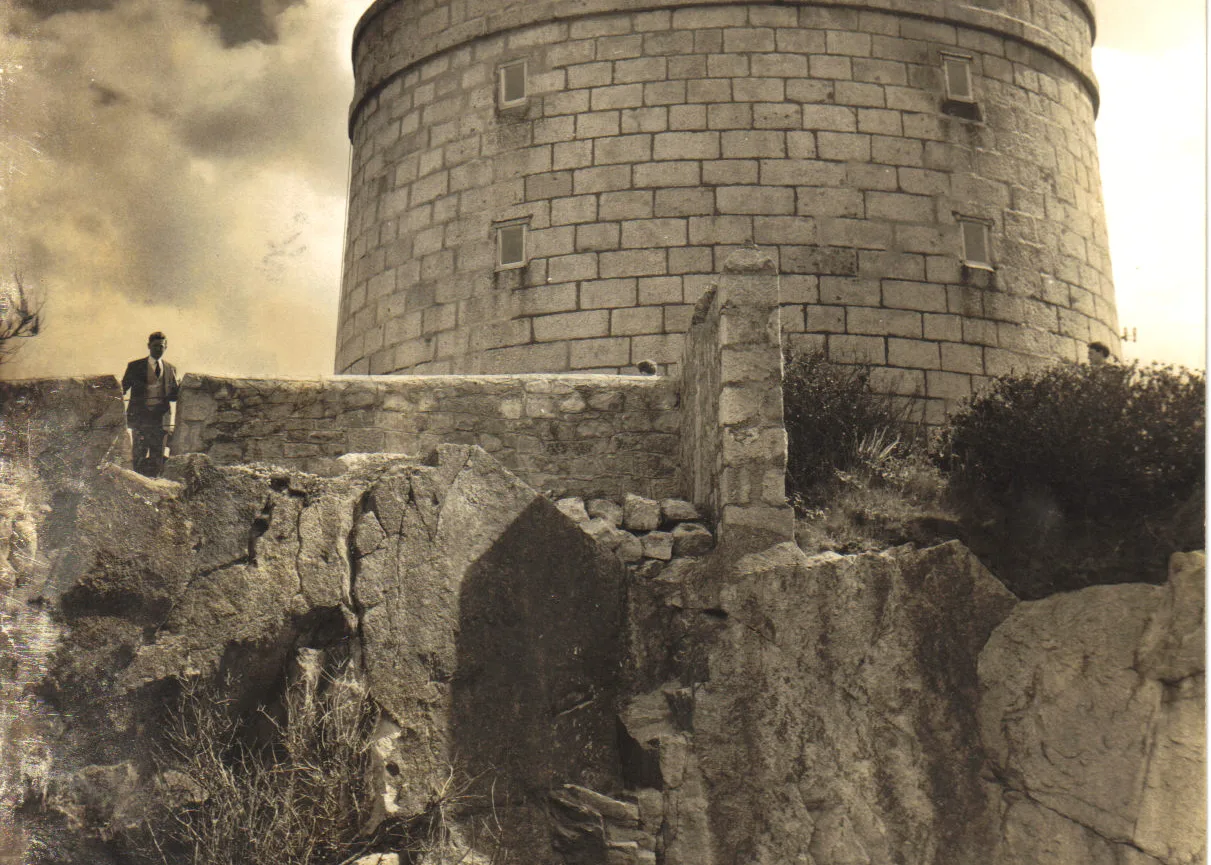
The Martello Tower at Sandycove is one of the most recognisable buildings in Irish literature. Perched above the sea on Dublin’s southern coastline, it is the setting for the opening of Ulysses and now home to a museum to James Joyce.
The order to build Martello Tower No. 11 was made, rather serendipitously, in June 1804. It was one of series of towers commissioned by William Pitt to defend against Napoleon. The design was inspired by a tower at Cape Mortella in Corsica, which had famously resisted a British naval attack. Although eventually captured, the tower’s defense was so effective that its design and name were adopted by the British for a new network of coastal fortifications. The word “Martello” is a mishearing of the original “Mortella.”
Around 50 tower were built along the Irish coast. Dublin alone had 28 towers, 16 to the south of the city and 12 to the north, forming a chain of lookout posts from Bray to Balbriggan. Built within sight of each other, they were designed to relay warnings quickly and respond to any approach from the sea.
The threatened Napoleonic invasion never came and the towers were gradually allowed to fall out of active use. From 1897, the tower and the battery in Sandycove were let out as individual sites to private tenants, including in 1904 to Oliver St John Gogarty whose most famous guest was James Joyce. In 1910 Gogarty purchased the the tower from the war Department and in 1925 he sold it to Mrs Catherine Cameron, who lived in the adjoining house ‘Rockfort.’
The celebrated Dublin architect, Michael Scott, purchased the Tower in 1954 with the intention of preserving it as a museum dedicated to James Joyce. Following a generous financial contribution from film director John Huston, restoration was carried out in the early 1960s. On 16 June 1962, the Tower was opened as a museum by Sylvia Beach, the publisher of Ulysses. In 1978, a new extension designed by Scott Tallon and Walker was added to house the museum collection.
By virtue of the vision of Michael Scott and the care and attention of previous curators and volunteers, more than a century after the publication of Ulysses and two centuries after the Napoleonic wars, the Tower welcomes visitors from around the world.