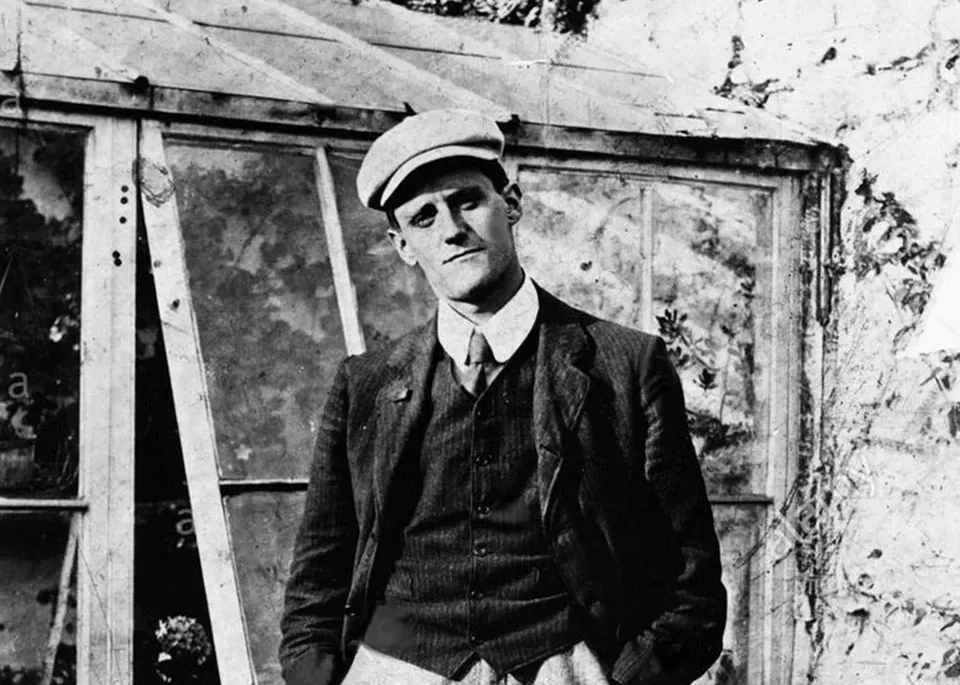
James Joyce (1882-1941) is a colossus of world literature. One of the most significant literary and artistic figures of the 20th century, he has influenced generations of writers and scholars from Samuel Beckett to Emer McBride. In forging his work, he abandoned traditional modes of composition and in the process redefined the concept of prose creation.
Joyce’s major works, including Dubliners (1914), A Portrait of the Artist as a Young Man (1916), Ulysses (1922) and Finnegans Wake (1939), are characterised by this evolving style. What is distinctive is his use of new literary methods, including interior monologue, complex symbolism and breaking down conventions of text. His works, deeply rooted in his native Dublin, explore themes of identity, society, artistic development and the human condition.
Joyce structured his early writing around what he termed “epiphanies” or moments of sudden insight or revelation. A Portrait of an Artist follows Stephen Dedalus (the character based on Joyce himself) as he develops from a sensitive young student interested in taking holy orders, to the revelation of his vocation as an artist. As he sees a girl wading like a bird on Dollymount Strand, the sight of “the wonder of mortal beauty”, brings on moment of aesthetic arrest and in that moment commits his life to art and to being an artist: He vows “to live, to err, to fall, to triumph, to recreate life out of life!”
In 1904, Joyce was invited by Oliver St John Gogarty, a medical student and aspiring poet, to stay at a demilitarised Martello tower in Sandycove. Also living there was Gogarty’s friend, Samuel Chenevix Trench, an Anglo-Irishman with a strong interest in Irish culture. The three men shared the round room on the first floor of the tower. A month later, Joyce left Ireland with his partner Nora Barnacle, beginning a lifelong journey through continental Europe in pursuit of his literary vocation.
Joyce and Nora lived most notably in Trieste, Zurich and Paris where Joyce wrote Ulysses, which was published, after seven years of toil, on his fortieth birthday, 2 February 1922. A vast epic of the body and of the city, Ulysses is set on one day in Dublin, 16 June 1904 and follows the lives of three characters Stephen Dedalus, Leopold Bloom and his wife Molly. Joyce had kept the memory of his stay in the Tower and used it as the opening. The innovations in style Joyce employs in Ulysses act as rhetorical experiments that serve to break the narrative contract between the reader and the text. By challenging traditional notions of plot, character, and language Ulysses has become the most influential book of the twentieth century.
Joyce’s final work Finnegans Wake is deeply obscure. He worked ceaselessly on this book for seventeen years despite his failing eyesight. Inspired by the night and by the sound of the river, Finnegans Wake is a study in permanence. The themes and characters are dark eternal archetypes. H.C.E. is the everyman or Here Comes Everybody and his head is the hill of Howth. His wife A.L.P or Anna Livia Plurabelle is the river Liffey that runs through Dublin city. Inspired by the cyclical theories of Vico, Finnegans Wake in a continuous present tense integument slowly unfolds “all marryvoising moodmoulded cyclewheeling history”. Joyce died in Zurich in 1941 less than two years after publishing Finnegans Wake.